

This inside joke is so old, I barely remember where it started.
It began in a conversation with my India Marketing Brand team. For some reason, and in long-forgotten context, I was rambling on about what my dream role looks like.
“Look, I just want to sit back and spout wisdom. Think deeply, offer direction, leave the execution to the team. And get well paid to do so. That’s the dream.”
At that point, someone on the team piped up and said,
“Basically, you want to become buzurg!”
Yes, basically.
Buzurg is a Persian loanword that’s made its way into Urdu and Hindi. And, per Google Search, “…refers to a revered, venerable, or saintly person admired for their spiritual wisdom.”
So yes. I’d love to find that role. Where I can sit back in a comfortable armchair, offer my years of spiritual marketing wisdom to the team, while they sit around me, gazing in rapt adoration, and then go back to do their jobs a mite better - courtesy said spiritual marketing wisdom.
Cut to a few short years later. I’m still at the same company, in the same(ish) role.
But AI is helping me become buzurg.
Here’s the story.
Survival first, spiritual wisdom later
To understand how I ended up here, we have to rewind a bit – to my first year at Google, over twelve years ago.
Having spent all my life prior to that at creative and digital agencies, walking into a massive global tech company hit me like a freight train.
In agency land, your calendar was merely a polite suggestion, decisions happened over coffee in ten minutes, and “stakeholder alignment” meant checking whether your Creative Director had slept the night before.
At Google, my calendar abruptly became a non-negotiable operating system. My inbox began multiplying like gremlins fed after midnight. And every project came with a cast of global, regional, and local stakeholders worthy of a George R. R. Martin novel.
About six months in, staring down a wall of unread threads, I realised something had to change
So, out of sheer self-preservation, I became a productivity nerd. Not the 5:00 AM ice-bath, matcha-fuelled Notion-dashboard type. But the desperate kind who was simply trying to not drown in the deluge of email. Over the years, that’s driven me to set up email filters and automated labelling; master Inbox Zero (archive everything that needs no action from you), defend calendar blocks for deep focus; and build little routines so nothing slips through the cracks.
In hindsight, I was planting the seeds of High Functioning Laziness.
The art of High Functioning Laziness
I wrote recently about High Functioning Laziness – a phrase that sounds like an HR investigation waiting to happen, until you look under the hood.
Bill Gates is famously credited with saying he’d always choose a lazy person to do a difficult job, because a lazy person will find an easy way to do it. (Fact-check: Gates never actually said this. A Chrysler executive named Clarence Bleicher said a version of it to a US Senate committee back in 1947 – and the internet was simply too lazy to check before slapping Gates’s name on it.)
But, I digress.
High Functioning Laziness isn’t about slacking off, cutting corners, or churning out generic AI workslop for three other humans on your team to clean up at all odd hours. It’s about hoarding your finite cognitive energy for the handful of things a senior marketer and creative leader is actually paid to do.
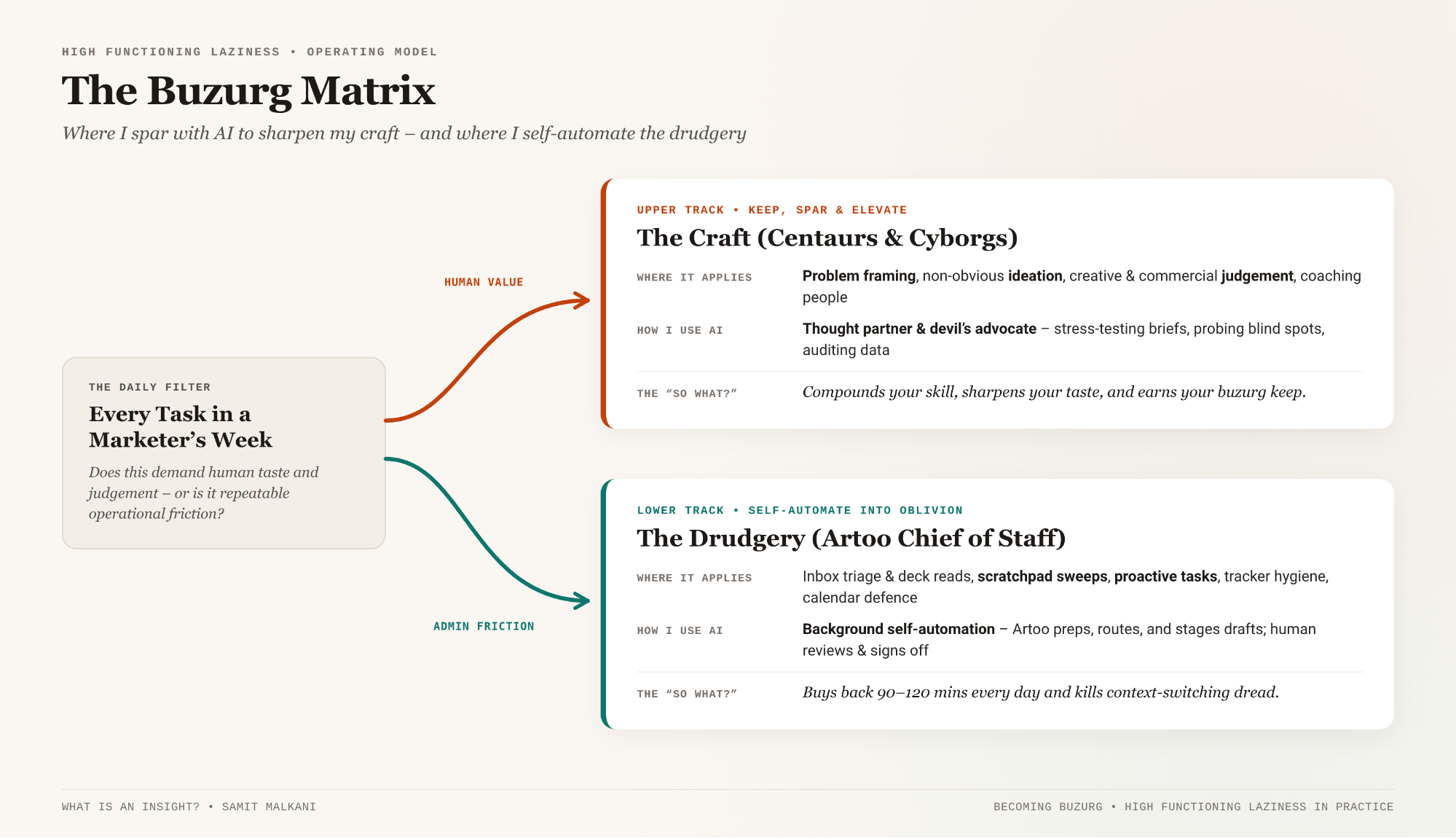
Strip away the noise of a modern corporate week, and my real human value in the age of AI boils down to three things:
Problem framing – going upstream to diagnose what business or human problem we’re actually trying to solve before anyone writes a brief.
Ideation – finding non-obvious creative leaps when algorithms (and committees) default to the safe average.
Judgement – applying twenty-plus years of experience, context and taste to pick what makes most sense.
(You’ve heard this before, I know.)
Earlier this year, in The One About The AI, Bro!, I touched on field research from Harvard, Wharton, and MIT Sloan studying how knowledge workers actually use AI. The researchers group users into three camps: Centaurs (who divide work cleanly between human strengths and AI strengths), Cyborgs (who weave human and machine thinking tightly together in every step), and Self-Automators (who hand the whole task over without friction – and quietly watch their own skills and judgement atrophy).
For the craft of marketing – strategy, creative direction, sharpening an insight, coaching my team – I stay strictly in Centaur and Cyborg mode. I want the AI to spar with me, stress-test my thinking, and leave me sharper in the process.
For the drudgery around the craft, however?
Inbox triage. Pre-read archaeology. Calendar Tetris. Transcribing my own chicken-scratch meeting notes. Updating status trackers.
That’s what I self-automate. With absolutely no regrets or guilt.
Nobody ever won a Grand Effie – or attained buzurg status – by heroically cross-referencing three dashboards, sixteen novel-length slide decks and fourteen stakeholder asks by hand.
Meet Artoo.
Sitting right at the core of my operating system today is Artoo – my personal AI Chief of Staff and Executive Business Partner.
Yes, I embraced my inner Jedi while naming him.
And no, I didn’t learn to code overnight. I continue to use English as my default coding language.
Here is how Artoo grew up, step by step:
Step 1: Baby Artoo - a custom Gem and a few duct-taped flows.
Version 1 started out last year as a custom Gemini Gem, paired with a handful of automated Workspace Studio Flows. Honestly? While he had my overall context, he was held back by limited functionality and 50 First Dates-style amnesia every morning.
Step 2: Moving into one persistent home – and giving him a “Soul”.
Hopping across four disconnected AI chat tabs guarantees generic output, because none of them hold your full context. The real breakthrough happened when I moved Artoo into our internal version of Antigravity – the developer-grade environment software engineers use. Wired directly into my email, calendar, docs, and tasks. Before building a single automation, I wrote him a Soul: a permanent constitution defining his role, his personality (loyal, candid, sardonic, allergic to corporate waffle), my strategic priorities, and strict guardrails. Rule #1: Draft, never auto-send an email to another human without my explicit sign-off. Rule #2: Never guess or invent a date – if it isn’t verified, flag it for me to confirm.
Step 3: Wiring a living, compounding brain.
We all know how much a good data pipeline matters to AI. As Artoo himself puts it: “A Chief of Staff without memory is just a stranger who types really fast.” For the past year, I’ve transcribed nearly every meeting I attend, alongside handwritten notes I scribble on my reMarkable tablet and email to myself at the end of the day for Artoo to digitise. Inspired by Andrej Karpathy’s LLM Wiki concept, I taught Artoo to maintain a private “Living Wiki” in my Drive. Every evening – and overnight while I’m asleep – he sweeps those transcripts and handwritten scribbles, extracts action items, logs real decisions into a decision ledger, and quietly updates living dossiers on my active projects and key stakeholders.
Step 4: Fixing the agent, not the output.
In Don’t Argue With The Chatbot, I wrote about watching power users in Jakarta scroll up to edit their original prompt instead of arguing with bad AI output. With a persistent agent, you go one level deeper. Whenever Artoo drafted an email opening with “I hope this email finds you well” (a form I’ve abandoned in the last few years) or produced a dense wall of text, I stopped manually rewriting the draft. Instead, I spent twenty seconds telling him to lock that correction into his permanent rulebook. Fifty corrections later, the compounding effect is wild: your agent stops sounding like a generic LLM and starts sounding more like you - or the Chief of Staff of your dreams.
Step 5: Adding specialist brains – and a cold-eyed fact-checker.
Left to himself, Artoo is deeply loyal – which, in AI land, means he will cheerfully grade his own homework an A+ when reality is closer to a B-minus. (I caught this early on when he rated an internal overlap analysis at 90%, only for a fresh audit to bring it crashing down to a much more realistic 70%.)
So I gave him a small council of specialist sub-agents to pull in on demand: strategic sparring lenses designed to challenge my blind spots (especially around navigating organisational dynamics, which I’ve always been rubbish at), plus a separate analytical agent named Lt. Commander Data. (I’m living proof that you can love both, Star Wars and Star Trek!) Data’s sole job is, not surprisingly, to audit numbers, sources, and logic and make sure Artoo isn’t becoming too creative for my own good.
Augment, Delegate, Deprioritise: What Artoo actually does all day
Strip away the sci-fi nicknames, and everything Artoo runs for me every day falls into three buckets.
First, he augments my thinking.
At 8:00 AM every weekday, before I open my inbox, a 300-word Morning Brief from Artoo lands at the top of my screen:
My single biggest strategic bet for the day
Distilled context for every 1:1 and creative review ahead (pulled straight from our Living Wiki)
Fresh outside-in market signals
And any landmines to watch.
Later, before I write a deep creative strategy plan, or walk into a high-stakes conversation, he grills my assumptions first.
The “so what?”: My half-baked thinking gets bruised in private rather than in public – so I walk into rooms ready to offer sharper direction in half the time.
Second, he delegates the operational grind (without outsourcing accountability).
Every fifteen minutes in the background, Artoo runs a Proactive Tasks radar and a Scratchpad Sweep: scanning my inbox, chat pings, meeting transcripts, and handwritten reMarkable notes to catch open commitments, turn messy scribbles into tracked actions.
To help me not drown in a deluge of dense slides (including some painful workslop), Artoo auto-detects docs coming my way, and sends over summaries with key, relevant takeaways and suggested decisions and actions. Similarly, he sets up initial draft emails in my voice, saving me time and getting me started.
Whenever he handles purely logistical errands on my behalf (like chasing a missing pre-read or sorting out calendar slots), he writes from his own clearly badged alias (Artoo-for-Samit) with four separate callouts making it unmistakably clear an AI droid is writing for me.
The “so what?”: Nothing slips through the cracks on back-to-back Thursdays, I stop acting as human middleware between my notes and my inbox, and saving time never comes at the cost of human trust.
And third, he helps me deprioritise ruthlessly.
I’ve lost plenty of focus blocks, lunch blocks, gym workouts (and, often, the will to live) due to an unguarded calendar. Artoo runs a daily Meeting Governor that audits my week against my top priorities, flags low-leverage standing syncs to decline, defends my 9-to-6 working window and gym blocks, and filters out passive FYI noise (including learning never to draft a polite reply to an automated expense-report notification).
The “so what?”: I protect uninterrupted hours for the upstream thinking I’m actually paid for – instead of mistaking a packed calendar for doing my job.
The honest maths: time saved vs. pain saved
Whenever I show this setup to colleagues or fellow marketers, the first question is inevitably: “So how much time does this save you?”
Now, I’m not one of those AI bros who claims to work fourteen minutes a week from a cliffside infinity pool in Bali while my agents run Southeast Asia Marketing.
If I do the honest napkin maths across a typical workday – roughly 45 minutes saved on inbox triage, deck reading, and first-pass replies; 30 minutes rescued from digging through fifteen tabs of old docs and chat threads before 1:1s; 25 minutes saved on post-meeting note transcription and tracker hygiene; and 15 minutes spared from scheduling ping-pong – Artoo saves me 90 minutes to two hours every single day.
Call it an entire extra workday handed back to me every Friday.
Which is brilliant. I’ll happily take it.
Except, a few months into living this way, it hit me that time saved isn’t even the real prize.
The real unlock is the pain saved – and the quality of presence that fills the vacuum.
It’s eliminating that invisible, soul-sapping tax of context-switching fourteen times between 9:00 AM and 6:00 PM.
It’s silencing that low-grade 7:30 PM background hum of dread – the nagging suspicion that in Tuesday’s fourth back-to-back meeting, you promised someone something important and promptly forgot what it was.
It’s never again walking into a creative review or a 1:1 frantically skimming a doc for the first time while someone is already presenting Slide 4.
Instead, I show up calmer, better prepared, and genuinely present. I have the headspace to listen properly, ask the uncomfortable upstream question, push the creative work somewhere braver, coach my team with care, make it to the gym five days a week, and close my laptop on time to hang out with Saav and our six-year-old son.
Now, in the interest of journalistic honesty: has my team started sitting cross-legged around my armchair, gazing up at me in rapt spiritual adoration?
Regrettably, no. They still roll their eyes at half my jokes, and rightly so. Apparently, even frontier AI has its limits.
Right now, almost every corporate conversation about AI stops at the exact same headline: AI will save us time.
The slightly more evolved ones get one step further: AI will help us improve quality.
Both are true. Yet building Artoo over the past year has taught me that both miss the real starting point.
Hand a muddled, unexamined way of working to an AI agent, and all you end up doing is lobbing automated workslop grenades into your own week – and everyone else’s.
You can’t teach a machine what great looks like in your craft unless you’ve spent years earning the domain depth and taste to recognise it yourself.
You can’t wire an agent to compensate for your blind spots without the self-awareness – and occasional bruising of the ego – required to admit what your blind spots actually are.
And you can’t automate your operating system until you’ve paused long enough to unpack how you actually think, which 20% of your job genuinely moves the needle, and how much of your week was just polite corporate busywork masquerading as work.
If there’s one thing I’ve learned about AI recently, it’s this: to unlock its real value, you first have to deeply know yourself, your domain, and how you work within it.
Only then can you unleash your inner buzurg.
That is the insight.
Samit