

I’ve sat in enough campaign reviews since 2010 - first on the agency-side, then on the client-side - to know the 55th-minute ritual by heart.
For fifty-five minutes, the most senior people in the room debate every frame, musical cue, and end-frame lockup of the big 30-second hero commercial.
Then, with five minutes left on the clock and everyone already closing their laptops, someone inevitably asks:
“And we have the social cutdowns covered, right?”
Make no mistake - I’m casting the first stone squarely at myself.
For a long time, that pecking order made complete sense.
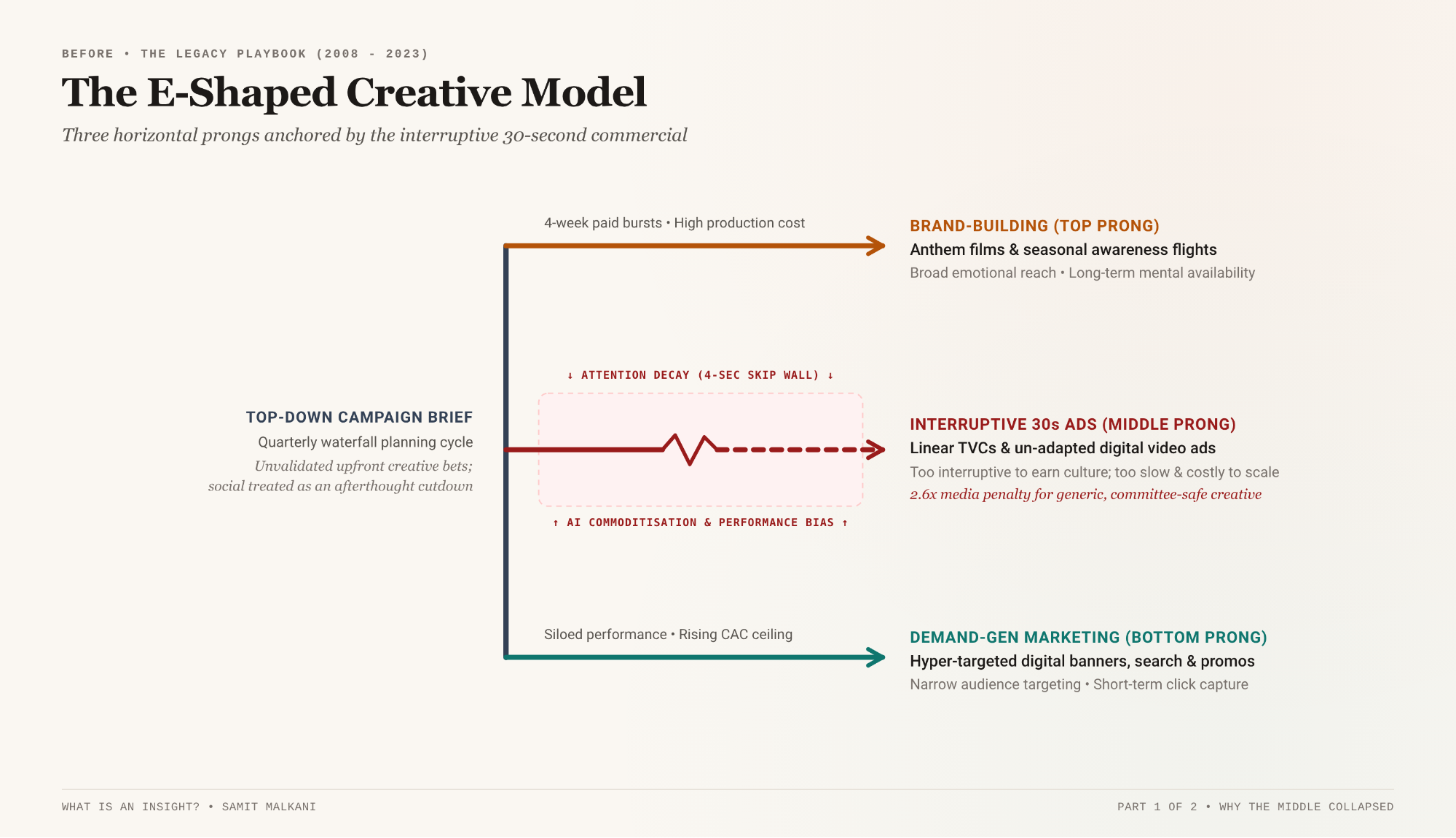
Modern marketing creative was shaped like a capital letter ‘E’: big brand anthem films at the top, the 30-second commercial holding everything together in the middle, and digital performance ads sweeping up clicks at the bottom.
Over the past few years, I’ve been studying where audience attention has actually gone; and, more recently, how generative AI is rewiring creative production.
And it’s dawned on me that the middle of that ‘E’ has quietly collapsed.
Borrowing a phrase economists popularised during the pandemic lockdowns:
When a single shock splits an economy onto two diverging tracks while the comfortable middle disappears, the future of creative isn’t E-shaped anymore.
It’s K-shaped.
Bear with me as I go down this rabbit hole. Because this shift didn’t start with LLMs. It’s been fifteen years in the making.
Everyone blames GenAI for breaking the old advertising playbook.
The truth is, marketing creative was already under pressure to change, long before a grubby set of fingers typed the first prompt ever into an LLM.
The first cracks showed up around 2008. Buoyed by digital marketing and always-on metrics, brands began over-allocating budgets to short-term digital metrics at the expense of long-term brand health. Causing overall marketing effectiveness to peak in 2012 and steadily decline [1]. Fun fact: this is true for even award-winning work.
By 2013, Byron Sharp’s How Brands Grow [2] and Les Binet and Peter Field’s The Long and the Short of It [3] proved what the smartest of us suspected: hyper-targeting narrow audiences caps your growth and sends acquisition costs through the roof. Mental availability requires broad, emotional mass reach.
Meanwhile, between 2013 and 2020, consumer behaviour rewired itself around social video - a shift that exploded during the pandemic lockdowns [4] as nearly half a billion new users came online looking for entertainment and human connection. The neat, linear funnel from Awareness to Purchase shattered into a “messy middle” [5], compressing discovery and buying into a matter of moments.
Around 2023-24, Mark Ritson called a truce on the pointless war of Brand vs Performance. He christened his new philosophy Bothism [6], and made the case for Brand and Performance. This was backed by WARC and System1’s The Multiplier Effect [7], which analysed over $100B in spend to show that uniting brand and performance drives an average 90% ROI uplift.
And as Gary Vaynerchuk argued in Day Trading Attention [8], marketers began realising that organic social wasn’t a niche side-channel - it was the new mass market and live proving ground for both.
Crucially, social networks had quietly morphed into entertainment media [9]. On these platforms, the price of attention is straightforward: entertain me, or teach me something.
Caught in the crossfire: the traditional 30-second commercial.
Un-adapted interruptive ads now hit a four-second skip wall and steep attention decay [10] on digital video platforms. I’ve seen this first hand - my teams will testify how hard I’ve tried to get our ads to gain organic traction on our social channels, and how I’ve failed every time.
And then came GenAI.
Flipping the old social video model on its head.
(Yes, I know you’ve heard this before, but allow me to construct my argument brick by brick. Thank you.)
With production being democratised overnight, the volume of content has exploded - saturating feeds so badly that Gartner predicts that half of consumers [11] would pull back from traditional social platforms altogether due to synthetic noise and AI slop. There’s already evidence of this if you read through the comments threads.
Before AI, making things was slow and expensive, so the constraint was always making enough stuff.
Now that making stuff is fast and cheap, the scarce resource has flipped to human originality, craft, and curatorial taste. As Ethan Mollick puts it in The Overhang [12], slop can only be defeated by taste.
And the penalty for ignoring taste can be measured in the dollars you spend.
In The Extraordinary Cost of Dull [13], Adam Morgan, Peter Field, and System1 proved that generic, forgettable advertising requires 2.6 times more media spend to achieve the same growth impact as emotionally distinctive creative.
You’re basically paying more to bore your audience, and get them to buy your product despite your advertising, not because of it.
At the same time, what remains of the lower funnel has started turning into a machine-to-machine transaction. Consumers are beginning to hand comparison and purchasing over to autonomous “machine customers” [14] - AI agents shopping on their behalf. (Guess how I bought Diwali hampers this year?)
And when people ask AI answer engines for recommendations, peer-reviewed Generative Engine Optimization research [15] shows those models ignore paid ad slots entirely, heavily weighting earned press, authoritative reviews, and genuine human community conversation instead.
The E makes way for the K.
Put all of those forces together, and you get Nassim Nicholas Taleb’s Barbell Strategy [16] playing out in real time across marketing.
When a system comes under technological pressure, the fragile middle collapses first - and value migrates to the extremes.
For decades, we’ve issued quarterly briefs down the spine of the E and pushed work across three parallel prongs: brand films at the top, 30-second interruptive commercials in the middle, and performance banners at the bottom.
Now look at what happens when that middle prong vanishes - squeezed from above by collapsing human attention, and from below by AI commoditisation:
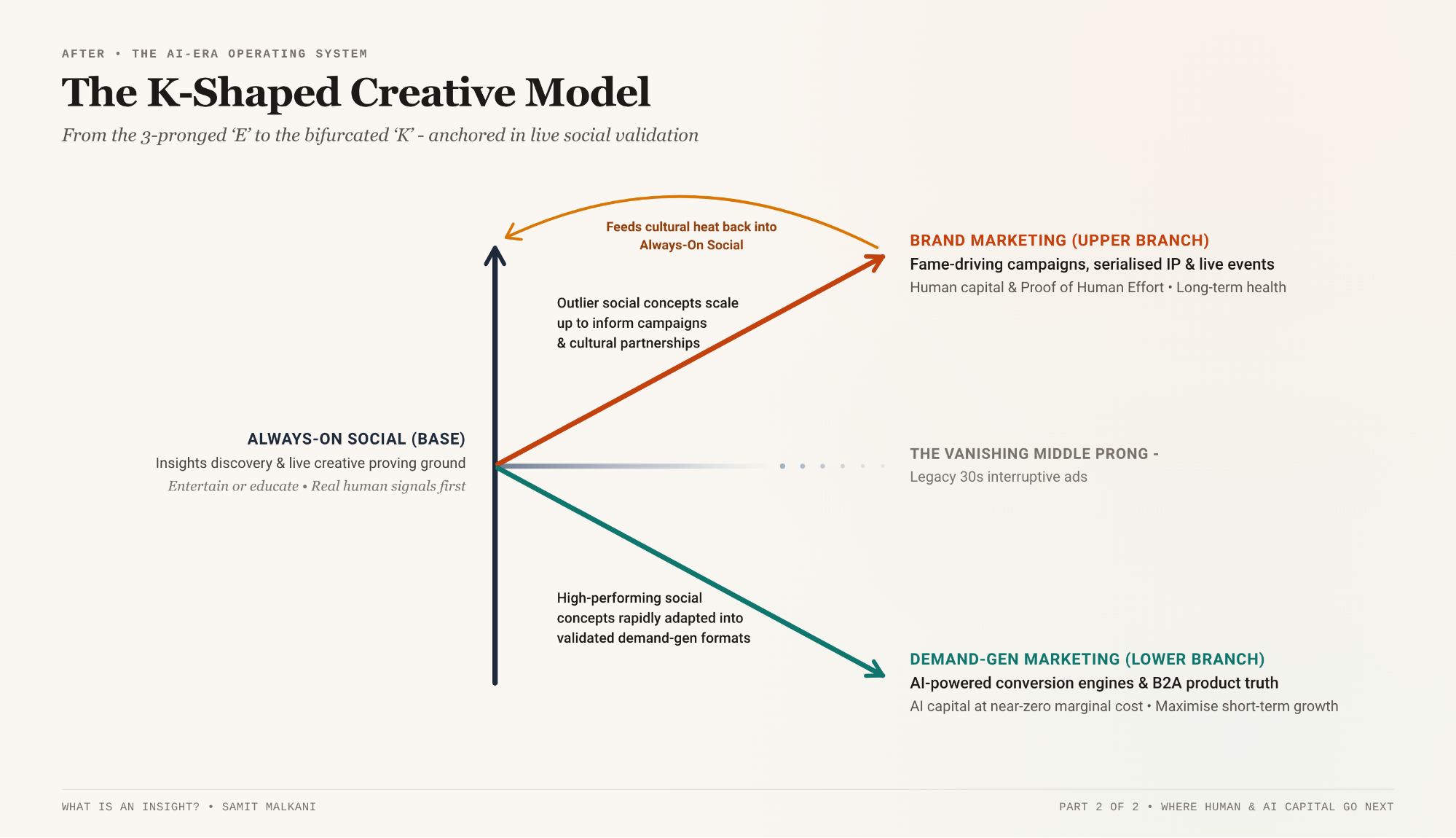
The model bifurcates into a K-shape, built on three connected engines:
1. The Base: Always-On Social as your live R&D lab.
Instead of sitting at the end of the assembly line waiting for social cutdowns to be discussed in the last five minutes, organic social becomes the spine of the entire marketing organisation. It maintains daily channel health, observes live cultural behaviour, and acts as an unforgiving creative proving ground. No big campaign gets funded on gut feel in a boardroom anymore - ideas earn their right to scale through real human Saves, Shares, and conversation.
2. The Upper Branch: Brand Fame and Proof of Human Effort.
When an organic social concept hits a cultural nerve and outperforms, it scales up the Upper Branch into fame-driving brand campaigns, creator-led entertainment IP [17], and cultural collaborations. Rather than isolated four-week ad bursts, brands begin acting like serialised broadcasters - wrapping medicinal product truth in a sweet entertainment shell, seeking active opt-in from audiences.
And in an ocean of low-cost synthetic content, visible Proof of Human Effort becomes the ultimate differentiator. Live physical events and experiential activations (which Kantar’s global Media Reactions study [18] ranks #1 in consumer ad equity), unscripted creator partnerships, and documentary-style craft rise to the apex of brand building. Generating the real human talkability that both buyers and AI engines cite, and feeding fresh cultural signals right back into Always-On Social.
3. The Lower Branch: AI-Powered Demand-Gen and B2A Truth.
Simultaneously, high-performing social winners drop down the Lower Branch into AI-powered conversion engines [19] operating at near-zero marginal cost. AI tools working under human guidance rapidly adapt validated creative across formats, languages, and audience segments at a speed no human-only studio could match. And as autonomous shopping agents take over comparison shopping, Lower Branch marketing expands into Business-to-Agent (B2A): pairing automated creative variants with clean, structured, verifiable product data and APIs that machines can read and trust.
The real bottleneck is organisational.
Even if frontier AI development froze tomorrow morning, existing models already have more than enough capability to rewire marketing.
Which means three big shifts for everyone leading marketing teams or agencies.
First, push human capital up, and AI capital down.
As lower-branch execution approaches zero marginal cost, leadership has to deliberately shift human talent and budget up towards unpredictable originality, culture, and long-term brand building. That means hiring and building pods across four non-automatable human skills identified by Ethan Mollick [12]: Deep Knowledge (evidence-based marketing laws), Wide Knowledge (cultural and cinematic vocabulary), Taste (knowing what great looks like and stripping out synthetic sameness), and Agency (actively experimenting along the jagged frontier [20]).
Rarely do all four live inside one human being - so you cast for them across a team. At the same time, we have to solve a ticking time bomb in early-career talent: recent field research from Harvard, Wharton, and MIT Sloan [21] warns that “Self-Automators” who hand thinking over to AI without friction suffer zero skill growth, just as empirical workforce data [22] shows junior hiring pipelines compressing. If we don’t create space for younger marketers to wrestle with upstream problems manually, we won’t have any Creative Directors with taste ten years from now.
Second, reshape your agency village around the ‘K’.
As repeatable production moves closer to automated workflows, the way brands partner with external agencies [23] has to mirror the K-shape too. Retire the theatre of briefing four agencies, disappearing for two weeks, and watching pitch decks. Run live collaborative sprints instead. Build a specialist “agency village” chosen for one or two genuine superpowers rather than generalist middle-prong filler. Partner with craft specialists who use AI to raise the creative ceiling [24], and evolve remuneration to reward business outcomes alongside creative outputs.
Third, stop funding unvalidated guesses.
Treat Always-On Social as the non-negotiable gatekeeper for creative quality. Let real human behaviour in the wild tell you which spark deserves an Upper Branch brand budget, and which workhorse deserves Lower Branch algorithmic scale.
So, if the collapse of the middle is this obvious, why do so many smart marketers still fund it every planning cycle?
After two decades on both sides of the client-agency table, I suspect it’s because the 30-second commercial was never really built for the consumer. It was built for the org chart - the one format roomy enough to give Brand five seconds of mood, Product ten seconds of features, and Sales a promo callout, before using paid media to force strangers to watch our internal peace treaty.
K-shaped creative destroys that hiding place. Unpaid humans in a social feed won’t sit through a committee compromise, and AI shopping agents at the checkout can’t be charmed by one.
If there’s one thing I’ve learned watching this shift up close, it’s this: the hardest part of K-shaped marketing isn’t mastering new AI tools or social formats - it’s having the spine to settle the argument inside the building, instead of outsourcing your indecision to the audience.
That is the insight.
Samit
Sources & Further Reading
Binet, L., & Field, P. (2017). Media in Focus: Marketing Effectiveness in the Digital Era - IPA / Thinkbox.
Sharp, B. (2010). How Brands Grow: What Marketers Don’t Know - Ehrenberg-Bass Institute / Oxford University Press.
Binet, L., & Field, P. (2013). The Long and the Short of It - IPA.
We Are Social & Hootsuite (2021). Digital 2021: Global Overview Report.
Rennie, A., & Protheroe, J. (2020). Decoding Decisions: Making Sense of the Messy Middle - BCG & Google.
Ritson, M. (2023). The Power of Bothism - Marketing Week / MiniMBA.
WARC, Analytic Partners, System1, & Binet & Field (2024). The Multiplier Effect.
Vaynerchuk, G. (2024). Day Trading Attention - HarperBusiness.
Newman, N., et al. (2024). Reuters Institute Digital News Report 2024 - University of Oxford.
Kantar (2024). Creative Effectiveness & Digital Video Attention Report.
Gartner Research (2023). Consumer Social Media Limit Forecast.
Mollick, E. (2026). The Overhang: Using Your Deep Knowledge, Wide Knowledge, Taste, and Agency - One Useful Thing / Wharton.
Morgan, A., Field, P., & System1 (2024). The Extraordinary Cost of Dull - eatbigfish & System1.
Scheibenreif, D., & Raskino, M. (2023). When Machines Become Customers - Gartner.
Aggarwal, P., et al. (2024). GEO: Generative Engine Optimization - ACM SIGKDD (arXiv:2311.09735).
Taleb, N. N. (2012). Antifragile: Things That Gain from Disorder (The Barbell Strategy) - Random House.
Goldman Sachs Global Investment Research (2023-2027). The Creator Economy Could Approach Half a Trillion Dollars by 2027.
Kantar Global Study (2024). Media Reactions: Top-Ranking Advertising Channels.
Pattisall, J. / Forrester Research (2023-2026). Generative AI Will Reinvent the Agency Business Model.
Dell’Acqua, F., Mollick, E., Lakhani, K., et al. (2023). Centaurs and Cyborgs on the Jagged Technological Frontier - Harvard Business School & Wharton.
Randazzo, S., Lifshitz, H., Kellogg, K. C., Dell’Acqua, F., Mollick, E., Candelon, F., & Lakhani, K. R. (2025/2026). Cyborgs, Centaurs and Self-Automators - Harvard Business School Working Paper 26-036.
Wilmers, N., Catipon, R., Massenkoff, M., & McCrory, P. (2026). How Employment Is Changing at Anthropic - The Anthropic Institute.
WARC Exclusive Research (2024). The Future of Strategy & Specialist Agency Ecosystems.
Dentsu Creative (2024). CMO Survey: Creativity at Speed & The Creative Ceiling.